
Empire Crypto: Essential Cryptocurrency Terms Explained!
Stepping into the world of digital assets often feels like attempting to learn a complex foreign language overnight. Between decentralized finance jargon, technical blockchain metrics, and internet slang, beginner and intermediate market participants can quickly feel overwhelmed by the sheer volume of market information. Understanding basic Empire Crypto vocabulary is not just about keeping up with conversations; it is the foundation for making smart, data-driven decisions. Without clear terminology, interpreting crypto data, analyzing cryptocurrency market data, and evaluating a crypto data solution becomes an uphill battle.

Core Blockchain & Network Fundamentals
Before diving into trading strategies, you must understand the underlying architecture powering digital assets.
Blockchain
A blockchain is an immutable, distributed digital ledger that records transactions across a network of computers. Rather than relying on a central authority like a bank, transactions are grouped into chronologically linked “blocks.”
- Use Case: Bitcoin uses blockchain technology to allow peer-to-peer monetary transfers across the globe without requiring traditional financial intermediaries.
Cryptocurrency
A cryptocurrency is a digital or virtual asset secured by cryptography, making it nearly impossible to counterfeit or double-spend. Most cryptocurrencies operate on decentralized networks using blockchain technology.
Nodes and Consensus Mechanisms
- Node: A computer connected to a blockchain network that maintains a full or partial copy of the ledger to validate transactions.
- Proof of Work (PoW): A consensus mechanism where network validators (miners) expend computational power to solve mathematical puzzles, securing the network and validating transactions.
- Proof of Stake (PoS): A consensus mechanism where validators are chosen to create new blocks and verify transactions based on the number of coins they lock up (stake) as collateral.
Smart Contracts
Smart contracts are self-executing computer programs stored on a blockchain. They automatically enforce and execute the terms of an agreement when predetermined conditions are met, eliminating the need for middlemen.
- Example: An insurance smart contract that automatically pays out funds to an account if verified weather data confirms a severe flight delay.
Market Structures & Exchange Mechanics
To execute informed trades, you need to understand where assets live and how orders move through financial systems.
| Exchange Type | Control | Liquidity Model | Best For |
| Centralized Exchange (CEX) | Third-party custodian | Order Book matching | High speed, fiat onboarding |
| Decentralized Exchange (DEX) | User self-custody | Automated Market Maker (AMM) | Privacy, direct wallet connection |
Centralized Exchange (CEX)
A CEX is an order-book-based platform managed by a central entity that facilitates buying, selling, and trading digital assets. Examples include Coinbase and Binance. While CEX platforms offer high liquidity and simple onboarding, users temporarily relinquish custody of their private keys to the platform.
Decentralized Exchange (DEX)
A DEX is a peer-to-peer marketplace where transactions occur directly between crypto traders using smart contracts without a central custodian. Platforms like Uniswap rely on automated code rather than corporate intermediaries.
Order Book vs. Liquidity Pools
- Order Book: A real-time electronic list of buy and sell orders for a specific asset organized by price level. Analyzing order book depth is a fundamental aspect of trading data analysis cryptocurrency.
- Liquidity Pool: A crowdsourced pool of tokens locked in a smart contract. These pools power trading on DEX platforms by allowing users to swap tokens instantly without needing a direct buyer-seller match.
Essential Trading & Market Data Terminology
Success in crypto trading relies heavily on understanding price action and interpreting cryptocurrency market data.
Market Capitalization (Market Cap)
Market Cap measures the total market value of a cryptocurrency’s circulating supply.
$$\text{Market Cap} = \text{Circulating Supply} \times \text{Current Token Price}$$
- Circulating Supply: The total number of tokens currently publicly available and circulating in the market.
- Total Supply: The total number of tokens currently in existence, minus any tokens burned.
- Fully Diluted Valuation (FDV): The theoretical market capitalization of a project if all possible tokens were in circulation.
Price Action Metrics
- All-Time High (ATH): The highest historical price point reached by a asset.
- All-Time Low (ATL): The lowest historical price point recorded for an asset.
- Volatility: A statistical measure of the dispersion of returns for a given security or market index. High volatility means prices move rapidly in short timeframes.
Order Types
- Market Order: An order to instantly buy or sell an asset at the best currently available market price.
- Limit Order: An order placed with a broker or exchange to buy or sell a set amount of a financial asset at a specified price or better.
- Slippage: The difference between the expected price of a trade and the actual price at which the trade executes, typically occurring during periods of high volatility or low liquidity.
Decentralized Finance (DeFi) Demystified
Decentralized Finance represents a paradigm shift away from traditional banking toward open, permissionless financial systems.
Total Value Locked (TVL)
TVL represents the sum of all staked or deposited assets sitting inside a specific DeFi protocol. It serves as a primary metric for assessing protocol adoption, user trust, and overall platform liquidity.
Yield Farming & Staking
- Staking: Locking up digital tokens to support a PoS network’s operations in exchange for earning staking rewards over time.
- Yield Farming: The process of deploying crypto assets across various DeFi protocols to maximize yield through interest payouts or bonus protocol governance tokens.
Stablecoins & Depegging
Stablecoins are digital tokens whose value is pegged to another asset, usually a fiat currency like the US Dollar.
- Collateralized Stablecoins: Backed 1:1 by traditional fiat reserves or over-collateralized crypto assets (e.g., USDT, USDC, DAI).
- Depegging: A event occurring when a stablecoin strays from its target ratio (e.g., dropping from $1.00 down to $0.94), presenting significant risk to DeFi participants.
Security, Wallets, and Key Management
Managing self-custody requires strict adherence to security protocols. Missing a key definition here can result in irreversible financial loss.
Keys and Addresses
- Public Key (Address): A cryptographically generated string of alphanumeric characters used to receive funds. Think of it as your digital email address or bank IBAN—safe to share publicly.
- Private Key: A secret cryptographic code that grants full access to the funds stored at a corresponding public address. Think of it as your account password—never share it with anyone.
- Seed Phrase (Recovery Phrase): A human-readable sequence of 12 to 24 random words generated by your wallet software that backs up your private keys.
Cold Storage vs. Hot Wallets
| Wallet Type | Internet Connection | Risk Level | Ideal Use Case |
| Hot Wallet | Always Connected | Higher (Vulnerable to malware) | Daily trading & DeFi interactions |
| Cold Storage | Offline Hardware | Low (Air-gapped security) | Long-term asset holding |
- Hot Wallet: A software-based wallet connected to the internet (e.g., MetaMask, Phantom). Convenient for daily use, but vulnerable to online vectors.
- Cold Storage: A hardware wallet (e.g., Ledger, Trezor) that stores private keys offline on a physical device. It provides maximum security against cyberattacks.
Advanced Analytics & On-Chain Metrics
Intermediate investors look beyond simple price charts by evaluating raw network activity using sophisticated data analytics cryptocurrency tooling.
On-Chain Metrics
- Active Addresses: The total number of unique wallet addresses actively participating in transactions on a blockchain within a given timeframe (e.g., Daily Active Addresses).
- Hash Rate: The total computational power dedicated to processing transactions and securing a Proof of Work network. Higher hash rate translates to greater network security.
- Gas Fees: Operational fees paid by users to network validators to process transactions on smart contract platforms like Ethereum. Gas prices fluctuate dynamically based on network congestion.
Understanding Market Data Aggregation
Professional traders monitor broader macroeconomic indicators and live data streams to validate trend strength:
- Crypto Market Data: Historical and real-time feeds including trading volume, order book depth, liquidity levels, and price feeds aggregated across multiple global exchanges.
- Crypto Data Solution: An integrated enterprise or retail software platform designed to ingest raw blockchain transactions and exchange APIs, converting them into clean, actionable analytical metrics.
About Empire Crypto Data
Navigating today’s vast digital asset landscape requires absolute precision. Without high-grade data tools, market participants are left relying on intuition rather than empirical evidence.
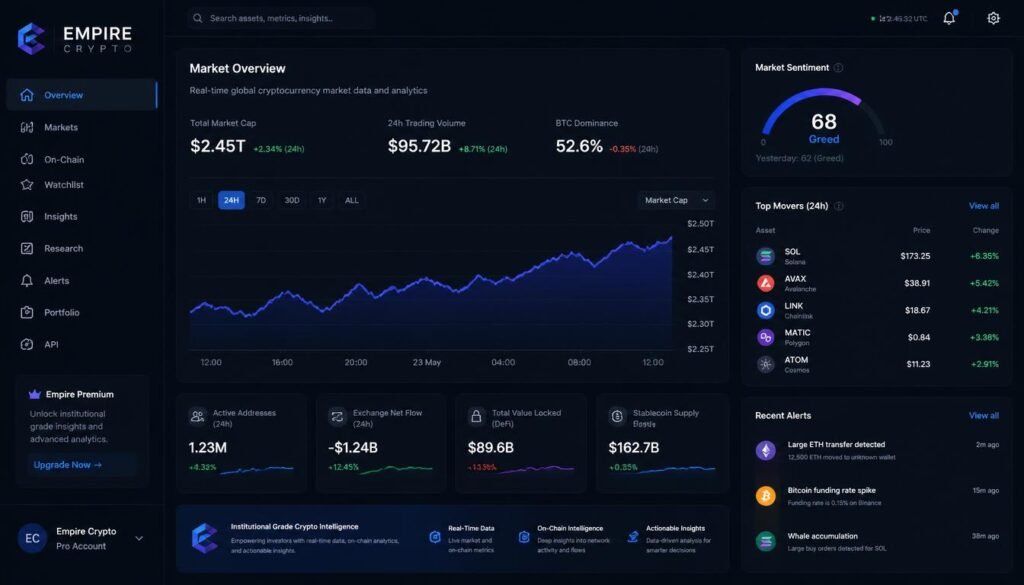
That is where Empire Crypto enters the picture. As an industry-leading crypto data company, Empire Crypto specializes in transforming messy, unstructured blockchain output into high-performance intelligence.
Why Empire Crypto Stands Out
- Cryptocurrency Data Reliability: Empire Crypto verifies every data pipeline across multiple nodes, ensuring maximum uptime and preventing false market signals.
- Comprehensive Market Coverage: From spot exchange data and derivative metrics to on-chain whale address monitoring, Empire Crypto delivers unified enterprise-grade visibility.
- Tailored Infrastructure: Whether you need historical metrics for algorithmic backtesting or real-time webhooks for DEX liquidity, Empire Crypto provides an adaptable crypto data solution.
By leveraging high-grade crypto data, Empire Crypto empowers retail investors and institutional funds alike to cut through market noise with accurate, high-frequency crypto data analysis.
Common Crypto Slang & Cultural Acronyms
Crypto culture moves fast, driven by internet communities across X (formerly Twitter), Telegram, and Discord. Here are key slang terms every user should recognize:
- HODL: Originally a famous forum typo for “HOLD,” now understood as an acronym for “Hold On for Dear Life”—referring to holding assets long-term despite market volatility.
- FOMO: “Fear Of Missing Out”—the psychological impulse to buy an asset when its price surges rapidly, often resulting in buying at local tops.
- FUD: “Fear, Uncertainty, and Doubt”—negative or misleading information spread intentionally to lower an asset’s price or harm its reputation.
- Degen: Short for “degenerate trader”—a investor who enters high-risk, unvetted trades without performing adequate due diligence.
- DYOR: “Do Your Own Research”—a universal advice reminder for investors to independently analyze cryptocurrency data analytics before deploying capital.
- Bull Trap: A temporary price rebound during a broader downtrend that tricks traders into buying before the asset resumes its downward trend.
- Bear Trap: A temporary price drop during an overall uptrend that tricks traders into selling short before the price resumes its upward momentum.
Frequently Asked Questions (FAQ)
What is the difference between a coin and a token?
A coin operates on its own independent native blockchain (e.g., Bitcoin on the Bitcoin network, Ether on Ethereum). A token is a digital asset built on top of an existing third-party blockchain protocol using smart contracts (e.g., ERC-20 tokens on Ethereum).
Why is cryptocurrency data reliability so important for traders?
Crypto markets trade 24/7 across dozens of fragmented global exchanges. Accessing reliable best crypto data ensures that your pricing charts, arbitrage alerts, and automated trading algorithms execute based on accurate market inputs rather than delayed or corrupted feeds.
How does Empire Crypto help beginners understand market data?
Empire Crypto simplifies complex raw data crypto streams into intuitive visual dashboards, accessible metrics, and real-time alerts. This helps new users identify genuine market trends without getting bogged down by raw code.
What are gas fees, and why do they fluctuate?
Gas fees represent the computational effort required to process transactions or execute smart contracts on a blockchain. When network demand spikes (e.g., during high-volume trading events or NFT launches), gas fees rise because users compete to have their transactions validated first.
Mastering the Language of Crypto
Building a strong foundation in digital asset terminology is your first major line of defense against market volatility and operational mistakes. From understanding the basics of public-key cryptography to interpreting complex data analytics cryptocurrency charts, mastering these terms turns confusing market movements into clear opportunities.
To stay ahead of market shifts, relying on generic information is not enough. You need enterprise-grade resources, verified analytics, and robust infrastructure.
Empower your portfolio with precision visual metrics, real-time analytics, and reliable market intelligence. Visit Empire Crypto today to leverage top-tier crypto data solutions designed to elevate your market understanding!
About The Author
