
Empire Crypto: Complete Guide to Crypto Risks
The digital asset ecosystem offers life-changing financial freedom, but navigating it without understanding risk is like sailing straight into a storm without a compass. In this definitive post from Empire Crypto, you will learn how to identify, analyze, and neutralize the core threats in Web3.
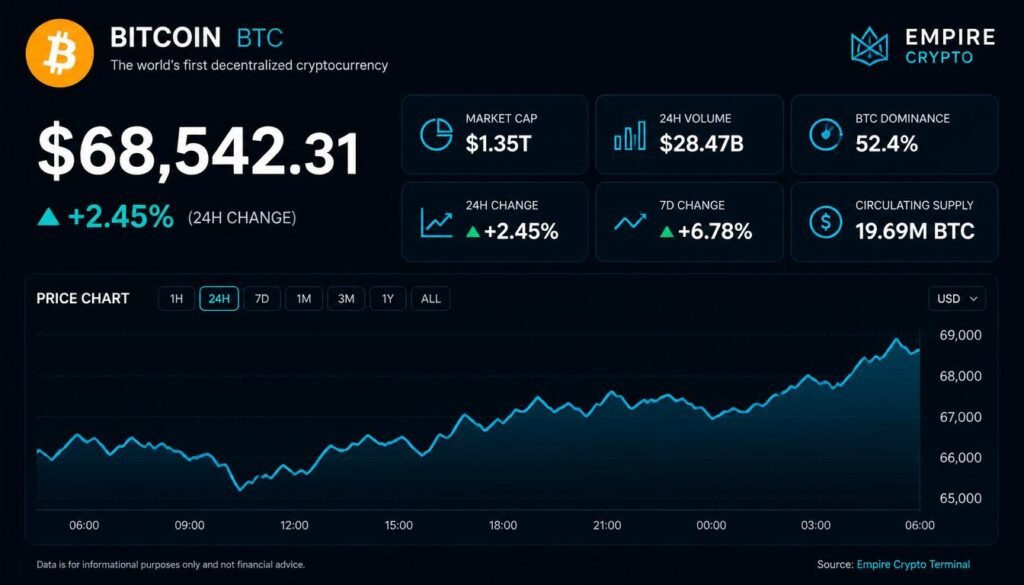
Why Understanding Crypto Risk Is Essential
Cryptocurrency is famous for producing massive returns in short timeframes, but it is equally capable of wiping out uneducated portfolios overnight. When you enter the market without analyzing crypto data, you aren’t investing—you are simply gambling.
At Empire Crypto, we break down risk management into structured, repeatable rules. By leveraging high-quality crypto data tools and reliable market signals, you turn volatile market noise into actionable intelligence.
Core Categories of Cryptocurrency Risk
To successfully protect your portfolio, you must first classify the distinct hazards present in the blockchain landscape. Empire Crypto divides these risks into four primary categories:
1. Market Volatility & Systemic Drawdowns
Cryptocurrency markets trade 24 hours a day, 365 days a year. Unlike traditional stock markets, there are no circuit breakers to pause trading during extreme sell-offs.
- Price Drops: Top-tier assets like Bitcoin and Ethereum routinely experience 20% to 30% pullbacks during bull runs and 80%+ drawdowns during bear cycles.
- Correlation Risk: During severe market panics, altcoins often drop significantly faster than Bitcoin, multiplying portfolio losses.
2. Smart Contract & Protocol Vulnerabilities
Decentralized Finance (DeFi) relies entirely on code. If a smart contract contains a logic bug, bad actors can exploit it to drain liquidity pools in minutes.
- Flash Loan Attacks: Exploitative arbitrage trades that drain decentralized exchanges.
- Reentrancy Bugs: Repeatedly pulling funds from a contract before its balance updates.
3. Liquidity and Execution Risk
Liquidity determines how easily you can convert an asset back into cash or stablecoins without crashing the price.
- High Slippage: Executing a trade at a significantly worse price than expected due to thin order books.
- Illiquid Altcoins: Tokens with low trading volume that leave investors trapped during market sell-offs.
4. Operational and Custodial Security
Managing your own private keys brings ultimate freedom, but it also removes institutional safety nets.
- Phishing & Social Engineering: Malicious dApps that request dangerous contract approvals.
- Loss of Keys: Forgetting seed phrases or failing to store private keys safely off-grid.
The Role of Accurate Cryptocurrency Data in Risk Reduction
You cannot manage what you do not measure. Accessing a premium crypto data solution allows you to see whale movements, liquidity concentration, and market sentiment before price action hits your exchange screen.
How Market Analytics Protect Your Capital
- Spotting Liquidity Traps: Empire Crypto tracks real-time order book depth to ensure you never enter positions with dangerous slippage.
- Tracking Exchange Inflows: Large spikes in Bitcoin deposits to centralized exchanges typically signal incoming sell pressure.
- Monitoring Funding Rates: Overheated perpetual swap funding rates warn traders when leverage is becoming overly crowded.
By using an established crypto data company like Empire Crypto, you replace gut-feeling trades with verified cryptocurrency market data.
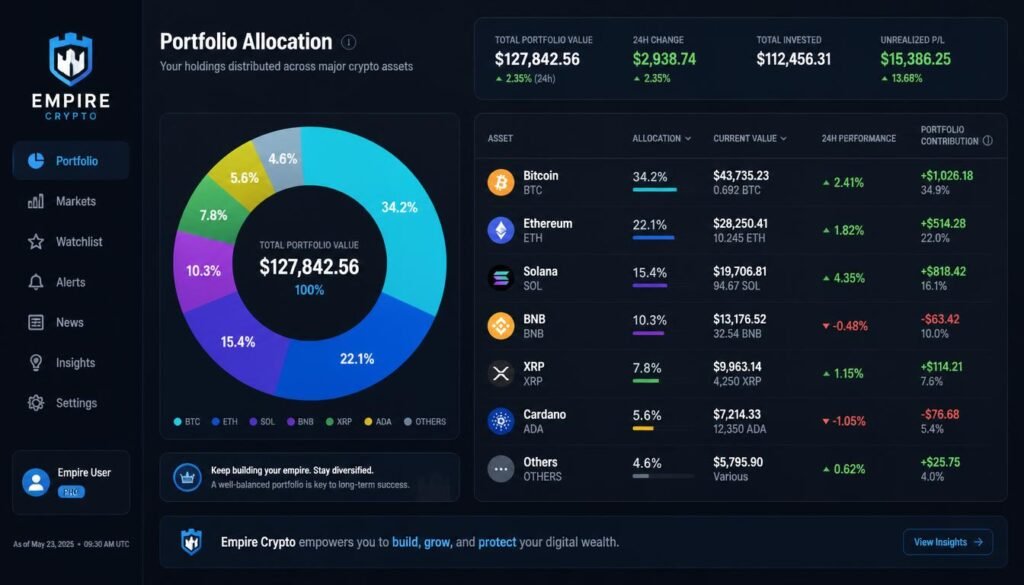
Beginner Guide: Fundamental Safety Rules
If you are new to Web3, following basic risk control principles will place you ahead of 90% of retail market participants.
Rule #1: The 1% to 2% Position Sizing Rule
Never risk more than 1% to 2% of your total account equity on any single trade.
Position Size Calculation Example:
- Total Portfolio Balance: $10,000
- Maximum Risk Per Trade (1%): $100
- Entry Price (BTC): $95,000
- Stop-Loss Price: $90,000 (5.26% loss distance)
- Allowed Position Size:$$\text{Position Size} = \frac{\text{Dollar Risk}}{\text{Trade Risk \%}} = \frac{\$100}{0.0526} \approx \$1,900$$
Even though your total position value is $1,900, your maximum potential loss if the stop-loss hits is exactly $100 (1% of your account).
Rule #2: Secure Storage Framework
- Hot Wallets (Browser/Mobile): Keep only small amounts needed for daily trading or Web3 interaction.
- Cold Wallets (Hardware Devices): Keep 80%+ of your long-term crypto holdings stored offline in hardware wallets like Ledger or Trezor.
Rule #3: Dollar-Cost Averaging (DCA)
Instead of attempting to time market tops and bottoms, allocate fixed dollar amounts on a weekly or monthly schedule. This strategy lowers your average entry price over time and removes emotional stress.
Advanced Guide: Analytics and On-Chain Risk Indicators
Intermediate and experienced traders rely on quantitative trading data analysis cryptocurrency tools to evaluate broader market health.
Evaluating Exchange & Token Liquidity
When examining small-to-mid-cap digital assets, Empire Crypto recommends analyzing two critical order book metrics:
- 2% Bid/Ask Depth: The amount of capital required to push price up or down by 2%. Thin depth means high volatility risk.
- Volume-to-Market-Cap Ratio: High trading volume relative to market cap indicates healthy liquidity and active interest.
Derivatives & Leverage Metrics
When data analytics cryptocurrency indicators show extreme leverage, market liquidations can trigger massive price cascades. Empire Crypto monitors these derivatives metrics:
- Open Interest (OI): Total value of outstanding derivative contracts. Rising OI alongside rising prices signals strong momentum, while rising OI near resistance signals a liquidation trap.
- Liquidation Heatmaps: Visual representations showing where leverage stop-losses are clustered across exchanges.
Why Empire Crypto Is Your Trusted Partner
In a fast-moving industry filled with noise, Empire Crypto delivers institutional-grade best crypto data designed for individual investors.
What Makes Empire Crypto Unique?
- Cryptocurrency Data Reliability: Clean, deduplicated, and verified data streams aggregated across over 300 centralized and decentralized exchanges.
- End-to-End Analytics: From basic historical price charts to complex derivatives metrics, Empire Crypto provides the exact tools needed to trade with confidence.
- Actionable Insights: Raw numbers are translated into direct, easy-to-read dashboard indicators for fast decision-making.
Frequently Asked Questions (FAQ)
What is the most common risk in cryptocurrency?
Market volatility is the most common risk. Crypto prices fluctuate rapidly due to market sentiment, macroeconomic events, and speculative trading. Using stop-loss orders and accurate crypto market data helps mitigate this risk.
How does Empire Crypto help me manage risk?
Empire Crypto provides real-time cryptocurrency data analytics, liquidity tracking, and market alerts. This allows you to evaluate market health before opening trades.
What is the 1-2% risk management rule?
The 1-2% rule states that you should never risk more than 1% to 2% of your total account capital on a single position. If your trade hits its stop-loss, your total loss is capped at that small percentage.
Is stored crypto safer in a hot wallet or cold wallet?
Cold wallets (hardware wallets) are far safer because they store your private keys offline, completely isolated from online hacks, phishing attacks, and malware.
Master Your Crypto Risk Management Today
Navigating cryptocurrency requires balancing potential rewards with disciplined risk management. By understanding market mechanics, setting clear position limits, and verifying assets using high-quality cryptocurrency market data, you protect your capital and build long-term wealth.
Don’t trade blindly in volatile markets. Equip your strategy with market-leading analytics, live on-chain metrics, and unmatched cryptocurrency data reliability with Empire Crypto today.
About The Author
