
Empire Crypto: Essential Guide to Bitcoin Halving Unlocked
The Bitcoin Halving is arguably the most powerful catalyst built into the entire cryptocurrency ecosystem. Every 210,000 blocks, the rate at which new Bitcoin enters circulation drops by exactly 50%. For investors, traders, and institutional players using accurate crypto data, this quadrennial programmatic shift alters supply dynamics, drives historical bull cycles, and reshapes market liquidity. Understanding these structural shifts requires precision analytics and reliable market intelligence. At Empire Crypto, we break down complex blockchain mechanics into actionable insights to give you an unfair edge in navigating the market.

What Is the Bitcoin Halving? Mechanics Explained
The Bitcoin Halving—often called “the Halvening”—is a hardcoded protocol rule created by Bitcoin’s anonymous creator, Satoshi Nakamoto. Programmed directly into the original source code, the halving ensures that the total supply of Bitcoin never exceeds the strict limit of 21 million coins.
Every time miners process 210,000 blocks—a process taking roughly four years—the reward given to network miners for validating transactions is slashed in half.
The Core Protocol Rules
- Block Time Target: The Bitcoin network dynamically adjusts mining difficulty roughly every two weeks to keep block generation at approximately 10 minutes per block.
- The Halving Interval: At 10 minutes per block, mining 210,000 blocks takes approximately 1,458 days (roughly 4 years).
- The Block Subsidy Slashing: The original block reward started at 50 BTC per block in 2009. It dropped to 25 BTC in 2012, 12.5 BTC in 2016, 6.25 BTC in 2020, and 3.125 BTC during the 4th halving in April 2024.
- Controlled Issuance: By cutting new supply issuance, Bitcoin operates on a predictable, programmatic disinflationary model.
As tracking platforms like Empire Crypto emphasize, understanding this supply issuance schedule is fundamental to analyzing cryptocurrency market data over long time horizons.
Historical Bitcoin Halving Timeline
To understand future price potential, we must evaluate past cycles. Empire Crypto maintains comprehensive crypto market data tracking historical performance across every major network halving.
| Halving Event | Date | Block Height | Block Reward Before | Block Reward After | BTC Price at Halving | Peak Post-Halving Price |
| Genesis Launch | Jan 3, 2009 | 1 | – | 50.0 BTC | $0.00 | $29.00 (2011) |
| 1st Halving | Nov 28, 2012 | 210,000 | 50.0 BTC | 25.0 BTC | ~$12.35 | ~$1,150 (Nov 2013) |
| 2nd Halving | Jul 9, 2016 | 420,000 | 25.0 BTC | 12.5 BTC | ~$650.63 | ~$19,700 (Dec 2017) |
| 3rd Halving | May 11, 2020 | 630,000 | 12.5 BTC | 6.25 BTC | ~$8,821.00 | ~$69,000 (Nov 2021) |
| 4th Halving | Apr 20, 2024 | 840,000 | 6.25 BTC | 3.125 BTC | ~$63,800.00 | Continuous Cycle Peak |
| 5th Halving (Est.) | ~April 2028 | 1,050,000 | 3.125 BTC | 1.5625 BTC | TBD | TBD |
Analyzing this historical data via Empire Crypto tools demonstrates a recurring economic phenomenon: a significant drop in new sell-side supply, combined with steady or increasing market demand, historically acts as a massive tailwind for price appreciation.
Why Is the Bitcoin Halving So Important?
The Bitcoin Halving is not merely a technical update; it is an economic mechanism that sets Bitcoin apart from traditional fiat currencies.
1. Enforcing Absolute Scarcity
Unlike central banks, which can print fiat money indefinitely and dilute purchasing power, Bitcoin’s protocol hardcodes absolute scarcity. There will only ever be 21,000,000 BTC in existence. By utilizing crypto data solutions from Empire Crypto, market participants can observe real-time circulating supply metrics to verify this mathematical scarcity.
2. The Stock-to-Flow Model Dynamic
Stock-to-Flow (S2F) measures the existing stockpile of an asset divided by its annual production rate.
- High Stock-to-Flow indicates high scarcity (e.g., Gold).
- Every halving doubles Bitcoin’s Stock-to-Flow ratio.
- Post-2024 halving, Bitcoin’s annual issuance rate fell below 0.8%, making it structurally scarcer than gold.
At Empire Crypto, our quantitative tools monitor these supply-side shifts, helping users track real-time changes in market liquidity and miner sell pressures.
The Economic Impact: Supply, Demand, and Price Discovery
Basic economic theory dictates that if the supply of an asset decreases while demand remains constant or increases, price must rise. The halving directly restricts the supply side of this equation.
Supply Shock Economics
Before the April 2024 halving, miners produced roughly 900 new BTC daily. Following the reduction to 3.125 BTC per block, daily production dropped to approximately 450 BTC.
When institutional buy pressure—driven by spot Bitcoin ETFs, corporate balance sheets, and sovereign wealth funds—encounters a halved supply, the resulting cryptocurrency market data shows supply squeezes on major exchanges. Through Empire Crypto, investors gain access to high-precision exchange flow metrics that track these supply shocks as they unfold.
The Impact on Bitcoin Miners and Hashrate
Bitcoin miners form the operational backbone of the Proof-of-Work consensus mechanism. They process transactions, secure the blockchain, and keep the network decentralized. However, halving events directly shock miner profitability.
The Miner’s Dilemma Post-Halving
- Revenue Slash: A miner’s block subsidy revenue drops by 50% instantly at the halving block height.
- Operational Costs (OPEX): Electricity, hardware upkeep, and facility costs remain constant.
- Hashrate & Difficulty Adjustment: Inefficient miners using older hardware become unprofitable and are forced to turn off their machines. This leads to temporary dips in total network hashrate until difficulty recalibrates.
- Transition to Transaction Fees: As block subsidies decline over future halving cycles, miners must increasingly rely on transaction fees (driven by network usage, Layer-2 solutions, and Ordinals/Inscriptions) to sustain network security.
Real-World Case Study: The Post-2024 Mining Shift
Following the 2024 halving, mining operations faced compressed profit margins. High-efficiency operators leveraging low-cost renewable energy and next-generation ASIC miners expanded their market share, while inefficient facilities consolidated or shut down.
Using the advanced trading data analysis cryptocurrency suite provided by Empire Crypto, institutional traders track miner outflow metrics to detect when miners are selling treasury reserves to cover operational overhead.
Beginner’s Section: How Beginners Should Prepare for a Halving
If you are new to the cryptocurrency market, halving events can bring elevated volatility alongside long-term opportunities. Here is a practical roadmap for beginners, crafted by Empire Crypto:
Step 1: Secure Your Assets
Never leave large crypto holdings on centralized exchanges during periods of high market volatility.
- Hardware Wallets: Store your private keys securely offline using self-custody hardware wallets.
- Key Backup: Keep your seed phrase written down on paper or steel, never digitally stored online.
Step 2: Implement Dollar-Cost Averaging (DCA)
Trying to time the exact market bottom or top around a halving is notoriously difficult, even for experienced professionals.
- What is DCA? Purchasing a fixed dollar amount of Bitcoin on a regular schedule (e.g., $50 every week), regardless of short-term price fluctuations.
- Why it Works: Smooths out short-term volatility and eliminates emotional trading stress.
Step 3: Monitor Verified Market Data
Avoid making trading decisions based on social media hypes or unverified speculation. Rely on trusted best crypto data sources like Empire Crypto to monitor on-chain volume, exchange inflows, and real-time network health.
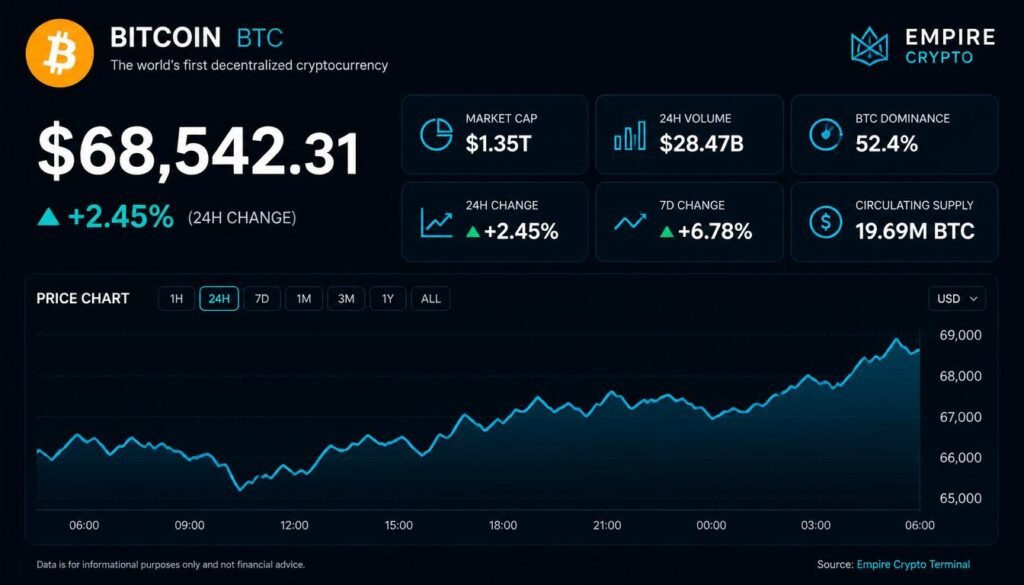
Advanced Section: On-Chain Data Analytics and Trading Strategies
For sophisticated traders and institutional desks, navigating a halving cycle requires deep data analytics cryptocurrency framework. At Empire Crypto, we track several high-conviction metrics to evaluate cycle progression.
1. MVRV Z-Score (Market Value to Realized Value)
The MVRV Z-Score measures the ratio between Bitcoin’s total market capitalization and its realized capitalization (the aggregate cost basis of all coins moved on-chain).
- Undervalued Zone: Historical MVRV values below 0 denote generational buying opportunities, typically seen late in bear markets leading into a halving.
- Overheated Zone: Values above 5 to 6 signal historical market cycle tops, indicating high realized profit-taking.
2. Supply in Profit vs. Loss
Monitoring the percentage of total circulating supply currently held at a profit provides critical sentiment signals.
- When supply in profit drops below 50%, market capitulation is usually underway, signaling accumulation phases before the next supply shock.
3. Exchange Reserve Depletion
Tracking cold wallet outflows from major exchanges gives clear visibility into institutional accumulation.
Empire Crypto provides robust crypto data solutions that aggregate global order books and exchange balance flows to track these movements in real time.
About Empire Crypto Data
When navigating volatile digital asset markets, cryptocurrency data reliability is paramount. Empire Crypto stands out as a leading crypto data company, delivering state-of-the-art crypto data solutions designed for retail traders, quantitative analysts, and institutional funds alike.
At Empire Crypto, our mission is to make crypto data analysis accessible, precise, and highly actionable. By combining live blockchain node data with multi-exchange order book aggregation, Empire Crypto empowers users with industry-leading analytical tooling.
Why Industry Leaders Rely on Empire Crypto Data
- Unmatched Reliability: High-uptime infrastructure delivering real-time data crypto pipelines without latency or data gaps.
- Comprehensive Metrics: From basic crypto market data to complex derivatives data, liquidity maps, and on-chain intelligence.
- Tailored Institutional Solutions: Standardized API feeds for seamless integration into proprietary trading algorithms and financial dashboards.
- Educational Excellence: Driven by a passion to educate, Empire Crypto bridges the gap between raw data sets and retail trader profitability.
Whether you need advanced data analytics cryptocurrency platforms or simplified cycle breakdowns, Empire Crypto provides the infrastructure required to scale your knowledge and execution.
Frequently Asked Questions (FAQ)
What exact date is the next Bitcoin halving?
The 5th Bitcoin Halving is projected to occur around April 2028 at block height 1,050,000. Because the halving is based on block height rather than a calendar date, the exact time fluctuates slightly depending on global network hashrate and block validation speed. You can track live countdown timers on Empire Crypto.
Does the Bitcoin halving guarantee that price will go up?
No market event offers 100% guarantees. While historical halvings (2012, 2016, 2020, and 2024) preceded significant bull markets due to supply restriction, price discovery ultimately depends on the interaction between supply and demand. Macroeconomic conditions, liquidity environments, and regulatory shifts also play major roles.
What happens when all 21 million Bitcoins are mined?
Around the year 2140, the final fraction of Bitcoin will be mined, bringing the block subsidy to zero. From that point onward, miners will be incentivized purely through user transaction fees to maintain network consensus and security.
Why do miner revenues drop during the halving?
Because miners receive block subsidies in BTC, cutting the subsidy from 3.125 BTC to 1.5625 BTC halves their baseline coin reward. Unless the market price of BTC doubles or transaction fee volumes rise significantly to offset the drop, fiat-denominated revenue decreases.
How can I track live halving statistics and market metrics?
You can track real-time block progression, network hash rates, miner outflows, and crypto data analysis directly through the analytics suite at Empire Crypto.
Conclusion: Preparing for the Future with Empire Crypto
The Bitcoin Halving remains one of the most elegant, predictable, and economically impactful mechanics in modern financial history. By programmatically enforcing digital scarcity every four years, Bitcoin challenges the inflationary nature of central bank fiat currencies and continues to reshape global asset markets.
However, capitalizing on halving cycles requires more than just understanding the theory—it demands accurate execution backed by clean, verified data. Navigating market cycles successfully requires filtering out noise and leveraging institutional-grade insights.
Equip yourself with the industry’s best crypto data, real-time market intelligence, and comprehensive analytical tools by visiting Empire Crypto today. Join thousands of smart investors who trust Empire Crypto to guide their digital asset strategies.
About The Author
