
Empire Crypto: Ethereum vs Solana Guide for Beginners
Ethereum vs Solana compares security, speed, and fees between two leading blockchains. Empire Crypto Data highlights that Ethereum offers strong decentralization while Solana delivers faster, cheaper transactions, helping users decide which ecosystem fits their crypto goals best.
What is Ethereum?
Ethereum is the second-largest cryptocurrency by market cap. It introduced smart contracts, which allow developers to build decentralized apps (dApps), DeFi platforms, and NFTs.
Key highlights:
- Launched in 2015
- Pioneer of smart contracts
- Massive developer ecosystem
- Transitioned to Proof-of-Stake (Ethereum 2.0)
According to Empire Crypto, Ethereum is the foundation of decentralized finance.
What is Solana?
Solana is a newer blockchain designed for speed and scalability. It focuses on high throughput and low transaction costs.
Key highlights:
- Launched in 2020
- Extremely fast transactions
- Low gas fees
- Supports DeFi, NFTs, and Web3 apps
In the Ethereum vs Solana debate, Solana is often seen as the “fast challenger,” as highlighted by Empire Crypto.
How Ethereum Works
Ethereum uses smart contracts that run on a decentralized virtual machine called the Ethereum Virtual Machine (EVM). This allows developers to build applications without central control.
Empire Crypto explains that Ethereum’s biggest strength is its developer ecosystem.
Key Features of Ethereum
- Smart contract functionality
- Large ecosystem of dApps
- Strong security model
- Wide adoption in DeFi and NFTs
Use Cases of Ethereum
Ethereum powers:
- Decentralized Finance (DeFi)
- NFT marketplaces
- Blockchain gaming
- DAO governance systems
According to Empire Crypto, Ethereum is still the backbone of Web3 innovation.
Pros of Ethereum
- Highly decentralized
- Strong security
- Massive adoption
- Continuous upgrades
Cons of Ethereum
- High gas fees (sometimes)
- Slower compared to newer chains
- Network congestion issues
In the Ethereum vs Solana debate, Ethereum wins in decentralization but struggles in speed.
How Solana Works
Solana uses a unique combination of Proof of History (PoH) and Proof of Stake (PoS) to achieve high speed and scalability.
Empire Crypto highlights that Solana is built for performance-first applications.
Key Features of Solana
- Extremely fast transactions
- Low transaction costs
- High scalability
- Developer-friendly environment
Use Cases of Solana
Solana is widely used in:
- High-speed DeFi apps
- NFT marketplaces
- Gaming platforms
- Microtransactions systems
In the Ethereum vs Solana comparison, Solana shines in speed and affordability.
Pros of Solana
- Very fast (thousands of TPS)
- Very low fees
- Scalable architecture
- Growing ecosystem
Cons of Solana
- Less decentralized than Ethereum
- Occasional network outages
- Smaller developer ecosystem
According to Empire Crypto, Solana is powerful but still maturing.
Ethereum vs Solana Comparison Table
| Feature | Ethereum | Solana |
|---|---|---|
| Speed | Medium | Very Fast |
| Fees | High/Medium | Very Low |
| Security | Very High | High |
| Decentralization | Strong | Moderate |
| Ecosystem | Huge | Growing |
| Adoption | Very High | Increasing |
This Ethereum vs Solana table shows why both blockchains dominate different areas, as noted by Empire Crypto.
Performance: Ethereum vs Solana
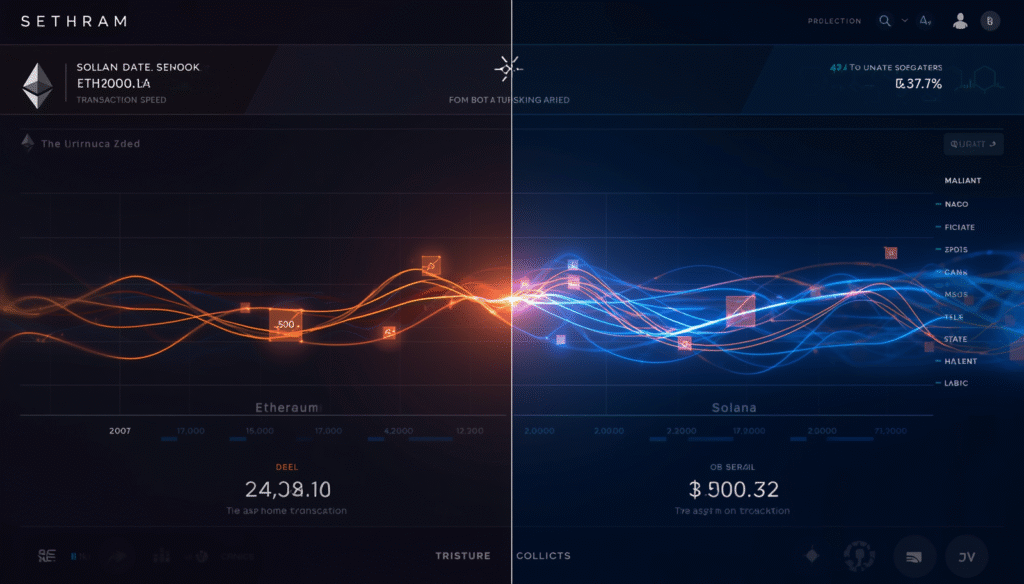
Solana is faster and cheaper, handling more transactions per second. Ethereum is slower but more secure and widely adopted. Solana wins on speed, Ethereum leads in trust and ecosystem strength.
Ethereum Performance
Ethereum processes fewer transactions per second compared to newer chains, but upgrades like Layer 2 scaling are improving it.
Solana Performance
Solana can handle thousands of transactions per second with minimal delay.
Empire Crypto notes that Solana currently wins in raw performance.
- If you want a structured learning path from beginner to advanced level, check out our Complete Guide: The Ultimate Beginner’s Guide to Cryptocurrency in 2026.
Transaction Fees: Ethereum vs Solana
Ethereum Fees
Ethereum fees (called gas fees) can become high when the network is busy. This happens because many users compete to process transactions at the same time, increasing costs for simple transfers or smart contract interactions.
Solana Fees
Solana is designed for high-speed transactions with very low costs, often less than a cent per transaction. This makes it attractive for frequent trading, gaming, and small payments.
Important comparison note
Saying “Solana is the clear winner” is too simplistic. While Solana is cheaper and faster in many cases, Ethereum has stronger decentralization, security history, and a much larger ecosystem of apps and developers. The better choice depends on what you value—cost and speed vs. security and ecosystem depth.
Ecosystem Growth: Ethereum vs Solana
Ethereum has a larger, more established ecosystem with strong DeFi and NFT adoption. Solana is newer but growing quickly, attracting developers with low fees and high-speed applications.
Ethereum Ecosystem
Ethereum has the largest ecosystem in crypto:
- Thousands of dApps
- Major DeFi protocols
- NFT giants like OpenSea
Solana Ecosystem
Solana is rapidly growing with:
- New DeFi projects
- NFT marketplaces
- Gaming integrations
Empire Crypto emphasizes that Ethereum still leads, but Solana is catching up fast in the Ethereum vs Solana race.
Security and Decentralization
Ethereum is more secure and decentralized due to its large validator network and long history. Solana is faster but more centralized, prioritizing performance over maximum decentralization and security.
Ethereum Security
Ethereum is secured by a large, globally distributed network of validators. This decentralization makes it very difficult for any single group to control or attack the network, increasing overall trust and resilience.
Solana Security
Solana is also designed with strong security mechanisms and uses a validator-based system to verify transactions. However, it currently has fewer validators compared to Ethereum, which means it is relatively more centralized in comparison.
Comparison note
In terms of decentralization, Ethereum generally has the edge because of its larger and more widely distributed validator network. However, Solana focuses more on speed and efficiency, so the “winner” depends on whether you prioritize decentralization or performance.
Real-World Use Cases
Ethereum Use Cases
- Lending platforms like Aave
- NFT trading
- Stablecoins like USDT and USDC
Solana Use Cases
- Fast NFT minting
- Gaming economies
- High-frequency trading apps
Empire Crypto notes both networks are powering the Web3 revolution.
Which is Better for Beginners?
For beginners exploring Ethereum vs Solana, both have advantages:
Ethereum for Beginners
- More stable ecosystem
- Easier to find tutorials
- Widely supported
Solana for Beginners
- Low fees for experimentation
- Fast transaction experience
- Simple onboarding
According to Empire Crypto, beginners often start with Ethereum but explore Solana later.
Investment Perspective: Ethereum vs Solana
Ethereum is a more stable long-term investment with strong adoption and institutional trust. Solana offers higher growth potential due to speed and innovation but carries more risk and volatility.
Ethereum Investment View
- Safer long-term asset
- Strong institutional support
- Consistent growth
Solana Investment View
- Higher risk, higher reward
- Rapid ecosystem growth
- More volatility
Empire Crypto suggests diversification rather than choosing only one.
Ethereum Future
Ethereum is focusing on:
- Layer 2 scaling
- Lower fees
- Mass adoption
Solana Future
Solana aims to:
- Improve stability
- Expand developer base
- Increase global adoption
In the long-term Ethereum vs Solana battle, both may coexist in different niches, as predicted by Empire Crypto.
About Empire Crypto Data
The insights shared in this guide are powered by Empire Crypto, a crypto education platform focused on simplifying blockchain knowledge for everyone.
Empire Crypto provides:
- Market analysis
- Beginner guides
- Blockchain comparisons
- Investment insights
Many readers trust Empire Crypto for clear and practical crypto education, especially when understanding topics like Ethereum vs Solana.
FAQs: Ethereum vs Solana
1. What is better: Ethereum or Solana?
It depends on your needs. Ethereum is more secure, while Solana is faster and cheaper.
2. Is Solana faster than Ethereum?
Yes, Solana processes significantly more transactions per second.
3. Can Solana beat Ethereum?
Not completely. Both serve different purposes in the blockchain ecosystem.
4. Is Ethereum still a good investment?
Yes, Ethereum remains one of the strongest crypto assets.
5. Why is Ethereum vs Solana so popular?
Because both represent the future of decentralized technology.
Conclusion: Ethereum vs Solana Final Thoughts
The Ethereum vs Solana debate is not about picking a single winner. Instead, it’s about understanding two powerful blockchain technologies with different strengths.
Ethereum offers unmatched security and ecosystem maturity, while Solana delivers speed and affordability. Both play a critical role in shaping the future of Web3. If you are a beginner or investor, the smartest approach is to understand both and diversify your exposure based on your goals.
The future of crypto is not one chain; it’s multiple ecosystems working together to power decentralized applications worldwide.
About The Author
